All rules for Artists
On this page
Draft+ entries
Rule 1: Source non-obvious
Include sources for non-obvious additions or changes. Edits by verified artists are considered authoritative information and do not need to be further sourced.
(Applies to all entries)
Rule 2: No incorrect information
Do not add incorrect information.
(Applies to all entries)
Rule 3: No information removal
Do not remove information in a way that’s not in line with the content removal guidelines.
Clearly incorrect information and out-of-scope entries can usually be removed, however it is typically best to make an entry report first.
(Applies to all entries)
Rule 4: No duplicate entries
Do not create duplicate entries, unless for separating artist personas.
(Applies to all entries)
Rule 5: No duplicate information
Do not duplicate information between fields or different entries.
Some data duplication is allowed if there are significant upsides in usability.
(Applies to all entries)
Rule 6: Use correct fields
Use the correct entry fields when adding information. For example, do not put lyrics in the entry description.
(Applies to all entries)
Rule 7: Name required
All entries require a name.
If all the primary names are whitespace, add the Untitled tag.
(Applies to all entries)
Rule 13: No song entries by forbidden artists
Song entries where the main producer is listed under forbidden artists should not be added.
(Applies to all song & artist entries)
Rule 16: No mobile links
Some websites have a separate URL for pages meant to be viewed on mobile:
Always prefer adding the desktop version of the link.
(Applies to all entries)
Rule 17: No download links
Direct download links (on any field) to media files (such as .mp3 or .flac) and links to file-hosting services (such as Google Drive or Dropbox) are not allowed, even if they’re legal. If the content is officially distributed, link the artist’s page (e.g., on Piapro or a blog) instead.
File sharing website links are only allowed if the website supports user profile pages, and the user (uploader) page is directly navigable from the download link page (https://piapro.jp/ links for example). In other cases the download link location should be mentioned in the entry description instead.
(Applies to all entries)
Rule 18: No email links
Do not add email links.
(Applies to all entries)
Rule 19: No tracking links
When adding external links, remove extraneous URL elements (usually after ? or &). More on #1765.
(Applies to all entries)
Rule 20: Correct link category
Use the correct link category.
Link categories are available for the main entry types (songs, albums and artists).
Official= Links to content that the artist can directly control.Commercial= Official links that include commercial features (such as album/song purchase).Reference= Unofficial reference, such as wiki article.Other= Other unofficial and useful links that do not directly reference the entry.
(Applies to all song & album & artist entries)
Rule 22: No objective tag votes
Adding tag votes to objective tags is redundant, unless there is a need to highlight the tag.
(Applies to all entries)
Rule 30: No machine translations
Do not add machine translated/romanized titles or lyrics.
(Applies to all entries)
Rule 31: Valid translation
Translations should be correct. Do not attempt to translate if you do not know the language well enough.
Official translations are accepted in any case.
(Applies to all entries)
Rule 33: Japanese whitespace
Separate all words and particles with spaces when romanizing.
(Applies to all entries)
Rule 34: Chinese whitespace
For Pinyin, separate each character with a space when romanizing.
Special names and proper nouns are kept together.
(Applies to all entries)
Rule 35: Romanization capitalization
Capitalize all words that are NOT single kana particles (は、が、を、etc).
- E.g. 歌に形はないけれど would be romanized as ‘Uta ni Katachi wa Nai Keredo’.
(Applies to all entries)
Rule 36: No macrons for long vowels
Do not use macrons for long vowels.
- こおり is romanized as ‘koori’, not ‘kōri’.
(Applies to all entries)
Rule 37: Apostrophe after ん
If ん is followed by a vowel (including や・ゆ・よ), romanize it as n’.
- E.g. してやんよ would be romanized as “Shiteyan’yo’”.
(Applies to all entries)
Rule 38: Romanization は
は (ha) is romanized as ‘wa’ if it is used after a noun as a topic marker.
- E.g. 恋は戦争 would be romanized as ‘Koi wa Sensou’, the は is not part of a word and functions as a particle.
(Applies to all entries)
Rule 39: Romanization づ
づ is romanized as ‘dzu’.
(Applies to all entries)
Rule 40: Romanization を
を (wo) is romanized as ‘o’ if it is used after a noun as a direct object particle.
- E.g. 地球最後の告白を would be romanized as ‘Chikyuu Saigo no Kokuhaku o’.
(Applies to all entries)
Rule 41: Romanization へ
へ (he) is romanized as ‘e’ if it is used after the name of a place to indicate direction as a particle.
- E.g. 駆ける、星空の彼方へ would be romanized as ‘Kakeru, Hoshizora no Kanata e’, the へ is not part of a word and functions as a particle.
(Applies to all entries)
Rule 42: Identical name order
Use the same order as the original Japanese name for romanizations.
Usually this is “Lastname Firstname”.
(Applies to all entries)
Rule 43: Loanword romanization
Loanwords are romanized into their original language (e.g. コーヒー → coffee)
(Applies to all entries)
Rule 44: Honorific suffix dash
Use a dash with honorific suffixes on names when romanizing.
- お姉さん would be romanized as ‘Onee-san’.
(Applies to all entries)
Rule 45: Fully loanword names
Do not add the romanization if the entire name is composed of loanwords.
(Applies to all entries)
Rule 46: No AI-assisted audio transcriptions
AI-assisted tools are not allowed for audio transcription, as they are extremely inaccurate with languages like Japanese and Chinese and even more so with Vocaloid.
(Applies to all entries)
Rule 66: Artist credit required
All album and song entries require at least one artist credit (custom or a proper entry).
- Use the entry Unknown producer(s) if necessary.
(Applies to all song & album & artist entries)
Rule 69: No entryless artists
Each artist entry (including voicebanks) should be included in at least one song or album.
Exceptions:
- Base (“Unknown”) voicebank entries.
- People who play a large role in a vocal synth event (e.g. DJ).
- Associated artists for voicebanks.
(Applies to all artist entries)
Rule 70: No out-of-scope artist entries
Artists that are not voice-synth-related should not be added to the database.
For illustrators, this rule can be ambiguous.
- Stock photo credits should generally be credited with the custom artist feature (no entry).
- Illustrators with voice-synth related artworks should have an entry.
- Illustrators who collaborate a lot with different voice-synth artists should have an entry.
Artists that are directly participating/collaborating (including illustrators) should/can have artist entries: Animators, lyricists, other individuals, etc.
(Applies to all artist entries)
Rule 71: Artist source required
Artist entries require at least one external link or description.
(Applies to all artist entries)
Rule 72: No forbidden artists
Do not add artist entries for forbidden artists.
Additionally, do not add song or album entries for forbidden artists if they are the main producer.
(Applies to all artist & song & album entries)
Rule 73: No unconsented unofficial voicebanks
Artist entries for voicebanks created through any of the following methods are not allowed:
- The use of unlicensed, leaked, or otherwise illicitly obtained development kits
- Generated from existing voices without explicit consent from the author or appropriate terms of use.
Song credits should be added with the “custom artist” feature along with the unofficial voicebank/Jinriki tag. It is possible to further specify the methods used by tagging the song with the relevant child of the imported voicebank tag or with the VOCALOID V3 Developer Kit tag.
For example, a voicebank made with the VOCALOID V3 Developer Kit would fall under the first case, and most RVC models (besides those that have consent) would fall under the second. Note that some voicebanks, for example, Adachi Rei, have permissive licenses that freely allow for derivative creation, so consent is already granted.
(Applies to all song & artist entries)
Fan-made derivatives such as pitchbends and genderswaps such as Hagane Miku, should not be added as artist entries, as they are not voicebanks of their own. Corresponding tags should be used instead: https://vocadb.net/T/92/derivative.
- Official derivatives made or commissioned by the original creator of the voicebank, whether for Vocaloid or UTAU, are allowed.
(Applies to all artist entries)
Rule 76: No real-life names
Real-life names should not be added as aliases.
Real-life names can still be added, if that’s the main artist name.
(Applies to all artist entries)
Rule 79: Separate artist personas
Respect artists’ wishes to keep artist personas separate.
(Applies to all artist entries)
Rule 83: No circle name duplication
Do not unnecessarily duplicate (solo) circle names between the artist and the circle entry.
(Applies to all artist entries)
Rule 84: Valid artist image
Artist picture/image should be related to the artist.
- The main picture should be chosen based on the relevant guidelines.
(Applies to all artist entries)
Rule 85: Character designer and illustrator
Character designer only needs to be specified if it’s different from the illustrator.
(Applies to all artist entries)
Rule 86: Manager and voice provider
Manager only needs to be specified if it’s different from the voice provider.
⚠️ This rule has been deprecated
(Applies to all artist entries)
Tag the artist with the secondary artist types when appropriate.
For example, if an Animation producer (artist type) is responsible for the lyrics (as a role), the artist entry should be tagged with the lyricist tag.
(Applies to all song & artist entries)
Rule 165: No default avatars
Do not add default avatars to artist entries.
(Applies to all artist entries)
Rule 174: No sensitive personal information
Sensitive personal information should not be shared in entries or user profiles.
(Applies to all entries)
Rule 175: Official romanizations are valid
Official romanizations do not need to follow VocaDB’s romanization guidelines.
In this case the official romanization tag is required.
(Applies to all entries)
Rule 179: Respect the no-lyrics-allowed tag
If the main artist or song is tagged with no lyrics allowed, do not add any lyrics to their songs.
(Applies to all song & artist entries)
Finished+ entries
Rule 8: No name duplication
Missing names should not be copied between other name fields.
(Applies to all finished entries)
Rule 23: Valid description
The description should be objective and neutral.
(Applies to all finished entries)
Rule 24: Original language required
The original language field for entry names should not be “unspecified”.
(Applies to all finished entries)
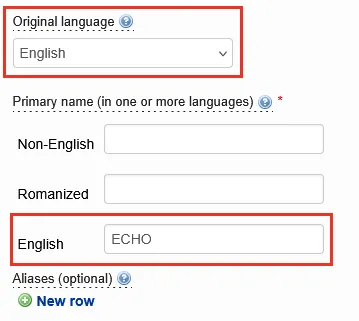

The ‘Original language’ title field should be filled in the corresponding ‘Primary name’ title field; the former should not be Unspecified, and the latter should not be empty (unless tagged with untitled).
For example, the song ECHO has its ‘Original language’ title field set to English, while its English ‘Primary name’ title field contains its proper title and is thus not empty.
An example showing the name field of the entry https://vocadb.net/S/68814:
Another example showing the name field of the entry https://vocadb.net/S/916132:
(Applies to all finished entries)
Rule 26: Prioritize official translations
Prioritize official translations/romanizations even if it is lesser known or breaks VocaDB romanization guidelines.
(Applies to all finished entries)
Rule 27: Correct entry subtype required
Entry subtype must be specified for album, artist & song entries.
(Applies to all finished song & album & artist entries)
Rule 28: Merge correctly
Merge lower-status entries into higher-status ones, or newer entries into older ones.
(Applies to all finished entries)
Rule 29: No new non-English translations
New non-English title translations should not be added without a good reason.
For example, the song entry ECHO should not receive new name/title translations.
Acceptable exceptions:
- Translation is used somewhere elsewhere (add for improved searchability).
- Translation is related to the original name (additional context/value). For example, マトリョシカ is from the Russian word “Матрёшка”, but is also known by its Romanized form “Matryoshka”.
(Applies to all finished entries)
Rule 57: Custom tracks
The “custom track” feature (no song entry) should only be used for out-of-scope tracks made by out-of-scope artists. Secret Sky 2020 (DJ Mix) for example.
(Applies to all finished song & album & artist entries)
Rule 59: Content tags
Content-based artist/album tags should only be used if a sizable portion of the album/artist’s songs are tagged.
A parent tag can also be used if the song entries are tagged with more specific child tags.
(Applies to all finished song & album & artist entries)
Rule 62: Valid support status
Support status is for crediting artists who play a minor role compared to the main artists in the same role. It should only be used when there’s a clear separation of main and support artists. If there is only one artist in a certain role, the support status should never be used.
Valid examples:
- Backing vocals, e.g., a background chorus when the main vocals are sung by another vocalist.
- Background illustrators (to distinguish them from the main illustrator).
Support status can’t currently be specified to a specific artist role. For example, if a song composer is also responsible for the background image, the support status should not be used.
Effects of support status:
-
Support status removes the artist(s) from the artist string and affects the search through the “Only main songs” filter.
-
Artists with support status never appear in the “artist string” of the song/album.
-
Support artists are shown in parentheses and after all other artists.
(Applies to all finished song & album & artist entries)
Rule 64: Limited artist information
If only the name of the artist is known, use the tag limited artist information on the artist entry.
(Applies to all finished artist entries)
Rule 65: Anonymous artist
If the artist is credited with some placeholder name, use the anonymous artist tag on the artist entry.
(Applies to all finished artist entries)
Rule 75: Correct YouTube link
Include at least one URL to the artist’s YouTube channel other than the Handle URL (uses @, e.g. https://www.youtube.com/@YouTube).
(Applies to all finished artist entries)
Rule 77: No honorifics
Do not add honorifics (e.g. “-san”/“さん”) unless the artists uses them on the name.
(Applies to all finished artist entries)
Rule 78: No producer name duplication
If the artist name includes the “producer” suffix (P or -P), do not duplicate a version without it as an alias.
Having both the “producer suffixes” (P and -P) is redundant as well. The artist entry should have the most common format (with or without the dash).
(Applies to all finished artist entries)
Rule 80: No composite names
Composite names consisting of parts that are pronounced the same way in different writing systems should generally be avoided.
Every field should contain only one version of the name:
- “Giga(ギガ)” is incorrect → should be separated into two names: Giga and ギガ.
- “Bumpyうるし(Urushi)” is incorrect → should be separated into two names: Bumpyうるし and BumpyUrushi.
(Applies to all finished artist entries)
Rule 81: Correct artist type
Artist type specifies the most common role that the artist participates in, with some overrides.
- Music producer overrides cover artist if they have at least one composed/arranged song entry.
- Verified artists can request changing the chosen artist type.
The available artist roles are limited and serve as approximations. - For example, the person responsible for the song image should be credited with the “illustrator” role, even if it’s technically something else (e.g., photographer).
(Applies to all finished song & artist entries)
Rule 82: Mention solo circle
If a solo circle is added as an artist alias instead of creating a separate entry, mention the circle alias in the artist entry description.
(Applies to all finished artist entries)
Rule 87: Keep previous members
If an artist leaves a group/circle, generally it’s best to mention this in the entry description(s) instead of unlinking the entries.
Verified artists can request unlinking from the circle/group in any case.
(Applies to all finished artist entries)
Rule 88: Label other voice synths
Engines for Other voice synthesizer (if available) need to be added as a tag and included in the voicebank entry name.
- If the voicebank has no separate engine, use the voicebank-as-engine tag.
- If engine is not known, use the unknown engine tag.
- Multiengine synths that have no clear or safe-to-assume base voicebanks usually have a corresponding “unknown” entry. These are grouped under the “unspecified voicebank engine” tag.
(Applies to all finished artist entries)
Rule 89: Voicebank language required
Specify the voicebank language if available.
(Applies to all finished artist entries)
Rule 90: Voicebank picture required
Specify the voicebank picture if available.
(Applies to all finished artist entries)
Rule 91: Base voicebank required
Specify the base voicebank if available.
(Applies to all finished artist entries)
Rule 92: Voicebank release date required
Specify the voicebank release date.
(Applies to all finished artist entries)
Rule 112: Remix classification
The “Remix” song type is used for variants of a song, often in a different genre.
(Applies to all finished song & artist entries)
Rule 115: Cover classification
The “Cover” song type is used for re-recorded versions of a song.
(Applies to all finished song & artist entries)
If the original artist is not directly involved with the derived version, the artist credit should not be duplicated from the original entry.
(Applies to all finished song & artist entries)
Rule 142: Vocalist entry credit required
Exceptions:
- Unofficial/Jinriki voicebanks should be credited as custom artists (no artist entry).
If the album/song includes in-scope vocals, and if the vocalist is uncredited, the artist entry Unknown vocalist(s) can be used.
- The entry Unknown vocal synth(s) or any of its derived artist entries can also be used to further narrow down the vocalist.
(Applies to all finished song & album & artist entries)
Rule 143: Credit earliest voicebank version
When in doubt, credit the earliest voicebank version.
- “Kamui Gakupo V4” → V4 Kamui Gakupo (Unknown)
- “Kamui Gakupo (Power)” → V3 Kamui Gakupo (Power)
(Applies to all finished artist & album & song entries)
Rule 144: Matching voicebank language
Song language should match one of the voicebank languages, unless the song is tagged with unsupported language.
(Applies to all finished artist & song entries)
Rule 160: Entry missing artists tag
If the song has no known artist credits available, use the entry missing artists tag.
(Applies to all finished artist entries)
Rule 172: Credit base voicebank
When in doubt, credit the base voicebank.
- “Hatsune Miku” → Hatsune Miku
- “Otomachi Una” → Otomachi Una (Unknown)
(Applies to all finished artist & album & song entries)
Rule 173: Unknown base voicebanks
Multiengine synths that have no clear/safe-to-assume base voicebanks should have a corresponding “unknown”-entry. These are grouped under the unspecified voicebank engine tag.
(Applies to all finished artist entries)
Approved entries
Rule 68: Known artist credits required
Approved album and song entries should include all the credited artists in accordance with other crediting rules.
(Applies to all approved song & album & artist entries)