All rules for Tags
On this page
Draft+ entries
Rule 1: Source non-obvious
Include sources for non-obvious additions or changes. Edits by verified artists are considered authoritative information and do not need to be further sourced.
(Applies to all entries)
Rule 2: No incorrect information
Do not add incorrect information.
(Applies to all entries)
Rule 3: No information removal
Do not remove information in a way that’s not in line with the content removal guidelines.
Clearly incorrect information and out-of-scope entries can usually be removed, however it is typically best to make an entry report first.
(Applies to all entries)
Rule 4: No duplicate entries
Do not create duplicate entries, unless for separating artist personas.
(Applies to all entries)
Rule 5: No duplicate information
Do not duplicate information between fields or different entries.
Some data duplication is allowed if there are significant upsides in usability.
(Applies to all entries)
Rule 6: Use correct fields
Use the correct entry fields when adding information. For example, do not put lyrics in the entry description.
(Applies to all entries)
Rule 7: Name required
All entries require a name.
If all the primary names are whitespace, add the Untitled tag.
(Applies to all entries)
Rule 16: No mobile links
Some websites have a separate URL for pages meant to be viewed on mobile:
Always prefer adding the desktop version of the link.
(Applies to all entries)
Rule 17: No download links
Direct download links (on any field) to media files (such as .mp3 or .flac) and links to file-hosting services (such as Google Drive or Dropbox) are not allowed, even if they’re legal. If the content is officially distributed, link the artist’s page (e.g., on Piapro or a blog) instead.
File sharing website links are only allowed if the website supports user profile pages, and the user (uploader) page is directly navigable from the download link page (https://piapro.jp/ links for example). In other cases the download link location should be mentioned in the entry description instead.
(Applies to all entries)
Rule 18: No email links
Do not add email links.
(Applies to all entries)
Rule 19: No tracking links
When adding external links, remove extraneous URL elements (usually after ? or &). More on #1765.
(Applies to all entries)
Rule 21: Tag usage rules
Follow tag usage rules for all the approved tags. Read tag descriptions before using them.
(Applies to all tag entries)
Rule 22: No objective tag votes
Adding tag votes to objective tags is redundant, unless there is a need to highlight the tag.
(Applies to all entries)
Rule 30: No machine translations
Do not add machine translated/romanized titles or lyrics.
(Applies to all entries)
Rule 31: Valid translation
Translations should be correct. Do not attempt to translate if you do not know the language well enough.
Official translations are accepted in any case.
(Applies to all entries)
Rule 33: Japanese whitespace
Separate all words and particles with spaces when romanizing.
(Applies to all entries)
Rule 34: Chinese whitespace
For Pinyin, separate each character with a space when romanizing.
Special names and proper nouns are kept together.
(Applies to all entries)
Rule 35: Romanization capitalization
Capitalize all words that are NOT single kana particles (は、が、を、etc).
- E.g. 歌に形はないけれど would be romanized as ‘Uta ni Katachi wa Nai Keredo’.
(Applies to all entries)
Rule 36: No macrons for long vowels
Do not use macrons for long vowels.
- こおり is romanized as ‘koori’, not ‘kōri’.
(Applies to all entries)
Rule 37: Apostrophe after ん
If ん is followed by a vowel (including や・ゆ・よ), romanize it as n’.
- E.g. してやんよ would be romanized as “Shiteyan’yo’”.
(Applies to all entries)
Rule 38: Romanization は
は (ha) is romanized as ‘wa’ if it is used after a noun as a topic marker.
- E.g. 恋は戦争 would be romanized as ‘Koi wa Sensou’, the は is not part of a word and functions as a particle.
(Applies to all entries)
Rule 39: Romanization づ
づ is romanized as ‘dzu’.
(Applies to all entries)
Rule 40: Romanization を
を (wo) is romanized as ‘o’ if it is used after a noun as a direct object particle.
- E.g. 地球最後の告白を would be romanized as ‘Chikyuu Saigo no Kokuhaku o’.
(Applies to all entries)
Rule 41: Romanization へ
へ (he) is romanized as ‘e’ if it is used after the name of a place to indicate direction as a particle.
- E.g. 駆ける、星空の彼方へ would be romanized as ‘Kakeru, Hoshizora no Kanata e’, the へ is not part of a word and functions as a particle.
(Applies to all entries)
Rule 42: Identical name order
Use the same order as the original Japanese name for romanizations.
Usually this is “Lastname Firstname”.
(Applies to all entries)
Rule 43: Loanword romanization
Loanwords are romanized into their original language (e.g. コーヒー → coffee)
(Applies to all entries)
Rule 44: Honorific suffix dash
Use a dash with honorific suffixes on names when romanizing.
- お姉さん would be romanized as ‘Onee-san’.
(Applies to all entries)
Rule 45: Fully loanword names
Do not add the romanization if the entire name is composed of loanwords.
(Applies to all entries)
Rule 46: No AI-assisted audio transcriptions
AI-assisted tools are not allowed for audio transcription, as they are extremely inaccurate with languages like Japanese and Chinese and even more so with Vocaloid.
(Applies to all entries)
Rule 147: Tag usage requirements
Tags should be included in at least one entry.
Abstract grouping tags do not require any connected non-tag entries.
(Applies to all tag entries)
Rule 148: Tag category required
All tags should specify the tag category.
(Applies to all tag entries)
Rule 149: Tag purpose
All tags should have at least one valid purpose:
-
Discovery: Tag is used for discovering related entries (all genre tags for example).
-
Search: Tag is used for searching or locating something already familiar (animated PV for example).
-
Statistical: Tag is used for calculating different statistics (western producer for example).
-
Informatory: Tag is used to convey information that doesn’t fit into the entry (entry missing artists for example).
(Applies to all tag entries)
Rule 150: Tag description required
All tags should include a valid description.
A tag’s description should explain its intended usage in clear English language.
For normal tags, skip generic usage instructions such as “tag for albums/artist/songs…”.
- Use “Valid for” restrictions instead.
Include source links when quoting information from external sources (such as Wikipedia).
(Applies to all tag entries)
Rule 151: No tag romanizations
It is not required (or recommended) to add romanizations for the tags.
Exceptions to this are tags such as sakura, that are simple, well-known, and more searchable with the added romanization.
(Applies to all tag entries)
Rule 152: No visual tags
Generally, tags should not be created or used for tracking visual details.
Some exceptions:
- Tags for MMD-related models (ISAO)
- Tags for the general PV style (comics PV)
- Tags for information/meta-details (mismatching vocalist PV)
(Applies to all tag entries)
Rule 168: No redundant tags
Tags should add new information to the entry. Creating new tags or adding tags to entries that replicate or derive information from the existing fields is not allowed, unless the tag provides significant value (for example for the search feature).
(Applies to all tag entries)
Rule 169: Valid tag naming
When naming tags, use common English language rules for casing.
- For example, Final Fantasy (proper noun) vs. progressive rock.
- Abbreviations such as “RPG” should also be written in capital letters.
Many tags are language-neutral, meaning that they’re not tied to any particular language.
- Examples of such tags are genres (such as rock) and themes (such as summer).
- For these tags, the non-English name should be translated to Japanese for practical reasons.
Unlike with other entry types, tag aliases do not need to be “real” aliases of the primary name. Tag that is used for multiple similar purposes can include multiple distinct “aliases”:
T/9493/teeth includes:
- toothbrush
- toothpaste
- tooth fairy
This improves tag searchability and avoids “duplicate” tags that are conceptually very similar.
(Applies to all tag entries)
Rule 170: Copyright tag usage requirements
Copyright tags can be created for a few reasons:
- Official: IP utilizes voice synth music within the product (anime/game/etc).
- Official: IP utilizes voice synth music to promote the product.
- Unofficial: (Original) fansongs inspired by the IP (Parody songs, Image songs, etc).
- Unofficial: Derived (remix/cover) songs of official IP music.
Avoid creating tags for 3 and 4 if they do not apply to at least 5 entries.
(Applies to all tag entries)
Rule 171: No obscure genre tags
Obscure genre tags should be avoided.
Genre tags that are hard to tell apart and/or are inconsistently used by artists should be merged in most cases.
(Applies to all tag entries)
Rule 174: No sensitive personal information
Sensitive personal information should not be shared in entries or user profiles.
(Applies to all entries)
Rule 175: Official romanizations are valid
Official romanizations do not need to follow VocaDB’s romanization guidelines.
In this case the official romanization tag is required.
(Applies to all entries)
Finished+ entries
Rule 8: No name duplication
Missing names should not be copied between other name fields.
(Applies to all finished entries)
Rule 23: Valid description
The description should be objective and neutral.
(Applies to all finished entries)
Rule 24: Original language required
The original language field for entry names should not be “unspecified”.
(Applies to all finished entries)
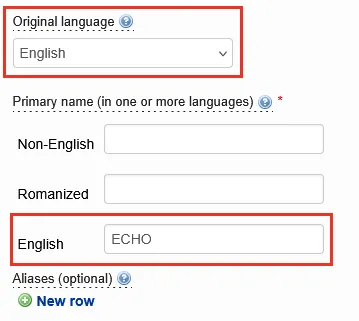

The ‘Original language’ title field should be filled in the corresponding ‘Primary name’ title field; the former should not be Unspecified, and the latter should not be empty (unless tagged with untitled).
For example, the song ECHO has its ‘Original language’ title field set to English, while its English ‘Primary name’ title field contains its proper title and is thus not empty.
An example showing the name field of the entry https://vocadb.net/S/68814:
Another example showing the name field of the entry https://vocadb.net/S/916132:
(Applies to all finished entries)
Rule 26: Prioritize official translations
Prioritize official translations/romanizations even if it is lesser known or breaks VocaDB romanization guidelines.
(Applies to all finished entries)
Rule 28: Merge correctly
Merge lower-status entries into higher-status ones, or newer entries into older ones.
(Applies to all finished entries)
Rule 29: No new non-English translations
New non-English title translations should not be added without a good reason.
For example, the song entry ECHO should not receive new name/title translations.
Acceptable exceptions:
- Translation is used somewhere elsewhere (add for improved searchability).
- Translation is related to the original name (additional context/value). For example, マトリョシカ is from the Russian word “Матрёшка”, but is also known by its Romanized form “Matryoshka”.
(Applies to all finished entries)
Rule 153: Parent tags
In most cases, child tags should describe a subset of the parent tag.
-
There are cases where the subset relationship isn’t as clear. Genre tags for example utilize the tag hierarchy for historical and stylistic origins.
-
Additionally, fusion tags such as folk metal are neither subsets of metal or folk music.
For tags with multiple separate parent tag candidates, pick the one that makes the most sense.
(Applies to all finished tag entries)
Rule 154: Related tags
Immediate parent/child tags should not be set as related tags.
(Applies to all finished tag entries)